
Simpson Shadehouse - Adelaide Botanic Gardens

28 February 2015
Flaked out!
Has anybody else noticed their Eucalypts shedding huge flakes of bark this year? They generally do shed bark at this time of year but there seems to be much more shedding this year than previous years. Oh, and that's today's koala flaked out!

23 February 2015
Adelaide Rosella
The Adelaide Rosella is thought to be a result of interbreeding between the Crimson Rosella which is found in much of south eastern Australia and the Yellow Rosella which is found along the River Murray. The latter is itself now considered to be a subspecies of Crimson Rosella. This photo was taken from the bedroom window so it's a little grainy.

15 February 2015
Correa decumbens 'Mount Lofty' (Spreading Correa)
This South Australian Correa started flowering before Christmas so it's definitely one of the Summer flowering Correas (most of which flower in Autumn or Spring). As its species name suggests, Correa decumbens is supposed to be "decumbent" or spreading although I have two other type plants which were sold as spreading but so far are anything but! However, this selection, often sold just as Correa 'Mount Lofty', does spread and forms a dense small bush that can fill a small, part shaded area in any temperate garden. It's frost and drought hardy but is happy in moist ground as well so it's quite adaptable. The flower of Correa decumbens is different from other correas in that it has anthers which protrude quite a long way beyond the petals whereas most other correas have anthers that are completely within or barely protrude from the petals.

14 February 2015
Peach (O'Henry)
Happy Valentines Day!! I took this photo a couple of weeks ago when the peaches were just beginning to ripen. This is an O'Henry peach which produces yellow freestone delicious fruit which ripens in early to mid February. We planted many fruit trees in 2009 and most are just starting to be productive bearers. This was the first fruit we've picked off the O'Henry. It's a variety which seems to suffer badly from peach leaf curl (a springtime fungus). We had some fruit form last year but it was damaged by the peach leaf curl and dropped off. This year a combination of spraying with Liquid Copper, physically removing leaves that still curled and a dry spring was most beneficial for fruit set. We can't control the weather and, because copper sprays kill beneficial insects like ladybirds and bees, spraying is limited to before bud burst and after all flowering; however, physical removal of remaining leaves affected seems to be very important. I did the same on curl leaf affected nectarines as well and all produced fruit with healthy non curled leaves replacing the affected ones.
All the peaches (and nectarines) have now been picked (and most have been eaten, sad to say!). We had 3.4kg of O'Henry peaches as well as 6kg of nectarines (5kg from a Goldmine and a kilo from 2 younger dwarf nectarines). We also picked over 4kg of plums and 2.5kg of Stella cherries. And we have apples and pears still to ripen/pick (first time fruiting for the latter). Then I hope we'll have winter citrus. Home grown fruit is SO much more delicious than supermarket varieties and these days there are so many dwarf or even sub dwarf fruit trees which can be grown in pots and which fit into small gardens or balconies quite easily. Most of them espalier against a wall or trellis if there's very limited space.

All the peaches (and nectarines) have now been picked (and most have been eaten, sad to say!). We had 3.4kg of O'Henry peaches as well as 6kg of nectarines (5kg from a Goldmine and a kilo from 2 younger dwarf nectarines). We also picked over 4kg of plums and 2.5kg of Stella cherries. And we have apples and pears still to ripen/pick (first time fruiting for the latter). Then I hope we'll have winter citrus. Home grown fruit is SO much more delicious than supermarket varieties and these days there are so many dwarf or even sub dwarf fruit trees which can be grown in pots and which fit into small gardens or balconies quite easily. Most of them espalier against a wall or trellis if there's very limited space.
11 February 2015
Maybe I Was Wrong!
This morning's young "male" koala just might have been a slight misidentification on my part!

Classic koala pose!
I think this is a young male (there was typical male koala bellowing last night).

14 January 2015
Mother and child
This mother koala and her baby have been around the vicinity for a few weeks now. Before Christmas I mentioned to a neighbour that the pair had been in a river red gum down our driveway and the neighbour said that their family had seen the mother with baby on her back walking down their driveway a few days earlier. Last week when it was in the forties I saw the mother (with baby on her back) trying to scale a tree with far too much creeper on it to accommodate her. Then in the past couple of days they've been in the huge river red gum by the carport. We watched in horror last evening as the baby swayed in quite a strong wind at the top of the tree. He/she must have realised the peril and carefully crawled backwards down to mamma, clinging on for dear life! Whew! This afternoon mother and child were on the very lowest branch so I grabbed my camera and started clicking. The mother had to size me up as I clicked away and eventually must have thought I was no threat. She made her way down to the ground (baby on her back) and walked towards me, then circled me and headed for a gate that she clearly wanted to go through (but it was shut). She waited while I opened it, walked through, sniffed at a few things on the way and finally climbed up a plum tree onto one of our rainwater tanks. From there she jumped onto the roof of the shed (not easy with a baby on your back and I thought I might have had to help her up at one point). From there she got onto a Melaleuca and at the moment mother and child are sleeping in that. This photo was taken just as she was contemplating the leap from tank to shed roof!

13 January 2015
Solanum melongena (Eggplant 'Listada Di Gandia')
I found this eggplant in the wicking bed hiding under its foliage. Eggplants or Aubergines are a member of the Solanaceae family. Solanaceae is a diverse and interesting family because it includes such a wide range of well known plants including potato, tomato, eggplant, tobacco, cape gooseberry, capsicum and chilli, goji berry, cestrum and even petunia. But it also includes the poisonous deadly nightshade and mandrake!

07 January 2015
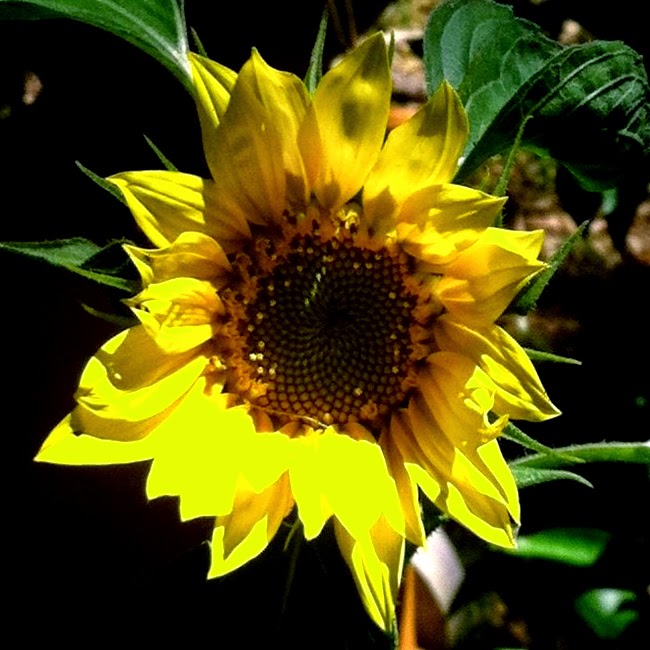
First sunflower of 2015
Not fully out yet but this is the first sunflower to actually flower this year.
06 January 2015
Gift from a friend
Many South Australians might recognise this plant as the State's floral emblem, Swainsona formosa or Sturt's Desert Pea. It thrives over much of outback Australia in arid, hot conditions. My task will be to keep it alive. Apparently they like a coarse, sandy, well-drained soil, lots of sun and they tend to suffer Fusarium wilt if watered from above. Conversely they also like a lot of fertiliser (slow release). So this will be a challenge!

Subscribe to:
Posts (Atom)